In this Blog, we will present irrefutable evidence proving the existence of a female pope; a popess. A woman who disguised as a man and became pontiff in 853 AD, and died in childbirth in the middle of a procession in 855 AD.
Let's start with this 12th-century manuscript:

Vatican manuscript 3762 (Vat.lat.3762), folio 124v, dating back to 1142 AD. See: https://digi.vatlib.it/view/MSS_Vat.lat.3762
Here you are the translation of the bottom paragraph:
“After Leo, John, an Englishman, born in Mainz, reigned for two years, seven months, and four days. He died in Rome, and the papacy was vacant for a month. He, as it was said, was a woman, and while still a girl, she was taken to Athens dressed as a man by a certain lover. She advanced so much in various areas of knowledge that no one could be found to equal her. Afterwards, she taught the trivium in Rome and had great teachers as her disciples and listeners. And because her life and learning enjoyed a high reputation in the city, she was unanimously elected pope. But while pope, she became pregnant by her lover. Not knowing the time of her delivery, when she was on her way from St. Peter's to the Lateran, she gave birth in a narrow passage between the Colosseum and St. Clement's, and after her death, as reported, she was buried in that very place. Because the Lord Pope always avoids that street, many believe that he does so because of his aversion to that event. Nor is she placed on the list of the Holy Pontiffs, both because of her female sex and on account of the foulness of the matter.” (Translation of the bottom paragraph of the Vatican manuscript 3762 [Vat.lat.3762], folio 124v)
There has been no chemical study that has proven that the ink, with which the history of the Popess was written in this manuscript, belongs to any century other than the 12th century.
This manuscript refutes the Catholic Encyclopedia's claim that the story of the Popess "first appeared in the mid-13th century." (Pope Joan, Catholic Encyclopedia):

Now, let's remember this passage from the Bible:
"The woman shall not wear that which pertaineth unto a man, neither shall a man put on a woman's garment: for all that do so are abomination unto the Lord thy God." (Deuteronomy 22:5, Holy Bible)
STATUES AND SCULPTURES
The Catholic Encyclopedia emphatically states: “This so-called popess is entirely a figment of the imagination.” (Catholic encyclopedia, Pope Joan)
If this is true, why are there so many statues and sculptures of "this so-called Popess" in St. Peter's Basilica today? Why were busts and statues of "this so-called female Popess" carved in the Vatican in the past, only to be altered or destroyed later?
FIRST STATUE
Statue of the female Pope located in the portico of St. Peter's Basilica:

This statue was sculpted in 1720 by Giuseppe Frascari.

She cannot be a representation of a female saint or a female martyr, as she wears an episcopal habit, a tiara (regnum) which was worn by the Popes of the High Middle Ages, a book, and the keys to heaven. Therefore, she is Peter's successor on the papal throne.
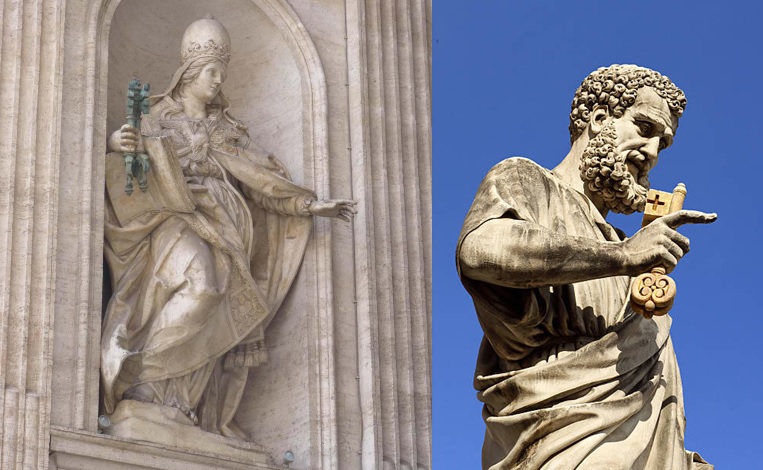

Compare the statue of the Popess in the portico of St. Peter's Basilica with "The Popess" from the Tarot of Marseille. Note the book held by the Popess in the Tarot of Marseille (created in the 17th century). The book represents the knowledge and erudition that characterized the female Pope:

The statue was sculpted 100 years after the tarot. It's clear that Frascari modeled his statue on the card of the Popess.
Regarding the female pope's erudition and knowledge, the reason why the book is used as her symbol, let us recall the words of Martin of Opava: "It is said that this Joanna was a woman who, as a child, was taken to Athens dressed as a man by a certain lover. There she mastered various branches of knowledge, until she reached an unparalleled level, and then, in Rome, she taught liberal arts and had great teachers among her students and audience. Her life and scholarship rose in the city; and she was elected pope." (Chronicon Pontificum et Imperatorum [Chronicle of the Pontiffs and Emperors] by Martin of Opava).
The Tarot of Marseille is not the only medieval graphic material that depicts the Popess with a book as a symbol of her knowledge and erudition. The French priest Jacques Philippe Forestius of Bergamo writes about Joan in his book De plurimis Claris scoletisque mulieribus (Ferrara, 1497). At the beginning of the chapter on the Popess (folium CXXXIII of the book, page 281 of the online publication), there is a woodcut depicting the Popess seated on a throne; the triple crown is on her head; with her right hand she imparts a blessing; and in her left hand she holds an open book:

Folium CXXXIII of the book De plurimis Claris scoletisque mulieribus (Ferrara, 1497)
The statue of the female Pope, located in the portico of St. Peter's Basilica, is wearing the tiara (regnum) which was worn by the Popes of the High Middle Ages (476 -1000 AD). The High Middle Ages is the time of Joan's pontificate. From left to right: Ioannes Anglicus, Leo VIII and Leo VII:

This statue also cannot be a representation of the church, because she is wearing a bishop’s robe, the tiara (regnum) worn by the popes of the middle ages, a book, and the keys to heaven. None of this features belong to the symbolism of the church according to the bible.
In Revelation 12:1, an allegory of the church is described as follows: “A great sign appeared in heaven: a woman clothed with the sun, with the moon under her feet and on her head a crown of twelve stars.” (Revelation 12:1, Holy Bible)
Nowhere in the verse does it say that the woman is holding the keys of St. Peter, nor that she is dressed in bishop's robes, nor that she is wearing a medieval papal tiara, much less that she is carrying a book in her hands.
Let's compare the Frascari's statue with the image of the Popess in the Marseilles Tarot, and with a painting depicting the Church described in Revelation 12:1:

Again, it's crystal clear that Frascari modeled his statue on the card of the Popess.
Scene from the film "Die Päpstin" (2009), in which Juana is seen, in her adolescence, reading a book:

SECOND STATUE
Second statue of the Female Pope in St. Peter's Basilica. This statue is located in the Central Nave of St. Peter's Basilica:

As with the first statue, this one cannot be a representation of a female saint or a female martyr, as she wears an episcopal habit, the tiara (regnum) worn by the popes of the Middle Ages, and the keys to heaven. Therefore, she is Peter's successor; the maximum ecclesiastical authority.

In the following map we indicate the exact location of this astonishing statue of Pope Joan in the Central Nave of St. Peter's Basilica:

BERNINI'S BALDACHIN
The Baldachin of Bernini is the largest and most important sculpture in the entire St. Peter's Basilica. Here you are a photo of Pope Francis' coffin at the foot of Bernini's Baldachin.

The four pedestals (or plinths), on which Bernini's Baldachin's columns rests, contain eight sculptures depicting the different stages of Pope Joan's childbirth:

Here you are three of these sculptures. Pay attention to the papal tiara and the Saint Peter's keys:

Seven of these faces represent Pope Joan's faces in the various stages of her labor and delivery. The last one represents her newborn baby:

Let's now look at the details of the heads. Notice how seven of them represent the pope in the different stages of labor. The last one, as we already mentioned, represents her newborn baby:

Pope Joan giving birth: Woodcut from a German translation by Heinrich Steinhöwel of Giovanni Boccaccio's De mulieribus claris, printed by Johannes Zainer at Ulm ca. 1474 (British Museum)

Detail of the sculpture of Pope Joan's baby in Bernini's Baldachin:

Note the face of the devil at the bottom of the sculpture. In this regard, let us recall the words of the Franciscan friar Martinus Minorita and Hermannus Januensis (of Genoa): “There was another false pope, whose name and year are unknown. For she was a woman, as the Romans acknowledge, of refined appearance, great learning, and, hypocritically, of high conduct. She disguised herself in men's clothing and was finally elected pope. While pope, she became pregnant, and while she was with child, the devil published it openly before everyone at court, shouting this verse to the pope: “PAPA, PATER PATRUM, PAPISSE PANDITO PARTUM” [O POPE, FATHER OF FATHERS, REVEAL THE PREGNANCY OF THE PAPESS].” (Chronica Minor; MGH:SS, XXIV, p. 184)
In the following map we indicate the exact location of the Bernini's Baldachin in St. Peter's Basilica:

Pope Benedict's coffin at the foot of Bernini's Baldachin:

Pope John Paul II's coffin at the foot of Bernini's Baldachin:

Since Pope Urban VIII, the coffins of all popes have been placed at the foot of a monument whose pedestals contain eight sculptures of Pope Joan:

In the ABC Primetime documentary “On the Trail of Pope Joan”, Catholic scholar John Nicholson explains that Bernini's eight sculptures in the Baldachin do not represent Pope Joan, but rather the favorite niece of Pope Urban VIII, who was pregnant at the time.
According to Nicholson, that pregnancy was very difficult, and “when Pope Urban VIII commissioned Bernini, he promised to dedicate it as a thank-you offering if his niece gave birth safely.” (ABC Primetime documentary “On the Trail of Pope Joan,” 28:55-29:11)
The question that Lila Diane Sawyer (American broadcast journalist) asks, after hearing this explanation, is exactly the same one we ask ourselves: “Does it really make sense that the Church would place the image of a Pope's niece at the center of the most sacred place in the city?” (ABC Primetime Documentary “On the Trail of Pope Joan,” 29:11-29:19)

Lila Diane Sawyer (American radio and television journalist) on the street of the female Pope (Vicus Papissae):

BUSTS AND STATUES OF THE PAPACY IN THE VATICAN, LATER MODIFIED OR DESTROYED
THE BUST IN THE CATHEDRAL OF SIENA
In the 17th century, Cardinal Baronious (Baronio, Cesare, Cardinal, 1538–1607), librarian of the Vatican, wrote that one of the 170 terracotta busts sculpted inside Siena Cathedral was of Pope Joan and had remained there for nearly 200 years. The inscription "Johanna Papa Femina" was engraved on the base of the bust.
Baronious also notes that, during the Renaissance, Pope Clement VIII ordered the bust to be transformed into Pope Zachary. The bust can be seen to this day in Siena Cathedral:

See the ABC Primetime Documentary “On the Trail of Pope Joan” (minutes 11:26 – 12:34).

Writer Donna Woolfolk Cross in the ABC Primetime documentary “On the Trail of Pope Joan,” explaining that the bust of Pope Zachary in Siena Cathedral was originally that of Pope Joan
This “fix,” or “makeover,” was primarily done out of fear of triumphant Protestantism. Protestantism was a movement initiated by Luther in 1517 and by 1601 had led to the famous "wars of religion" in Europe, which lasted until 1697.
Even the Catholic encyclopedia itself (which denies the existence of Pope Joan) confirms that, for more than 200 years, there was a bust in Siena Cathedral representing the female Pope, whose existence no one doubted at the time. Let's see:
"In the 14th and 15th centuries, this pope was already considered a historical figure, whose existence no one doubted. She had her place among the carved busts in Siena Cathedral. Under Clement VIII, and at her request, her bust was transformed into that of Pope Zachary." (Pope Joan, Catholic Encyclopedia)

Clement VIII (1592-1605), who ordered that the female Pope's bust (in Siena Cathedral) was transformed into that of Pope Zachary
THE DESTROYED STATUE
In the 14th century, a statue was built in memory of Pope Joan between Saint Clement and the Colosseum. In 1486, John Burchard, Bishop of Strasbourg and Papal Master of Ceremonies under Pope Innocent VIII (1503–1513), Alexander VI (1492–1503), Pius III (1503), and Julius II (1503–1513), organized a procession for Innocent VI. In his Liber Notarum, he records the encounter of this procession with the statue of Pope Joan and her son: "On his way out, as well as on his return, HE (THE POPE) CAME BY THE ROAD TO THE COLISEUM, AND BY THAT STRAIGHT STREET WHERE THE STATUE OF THE WOMAN POPE (IMAGO PAPISSAE) IS LOCATED IN REMEMBRANCE, IT IS SAID, OF POPE JOHN VII (OR VIII) HAVING GIVEN BIRTH THERE TO A CHILD. For this reason, many say that popes are not allowed to pass on horseback there. Therefore, the Lord Archbishop of Florence, the Bishop of Massano, and Hugo de Bencii, the Apostolic Subdeacon, sent me a reprimand" (Liber Notarum, John Burchard; RISS, XXXII pt. 1, vol. I, p. 176).
This statue, mentioned by John Burchard, was as real and familiar to medieval Romans as the Statue of Liberty is to Americans today. Below, we'll see how some medieval chroniclers described this intriguing statue.
Adam of Usk, a Welsh cleric, canonist, historian, and chronicler of the late Middle Ages, attended the coronation of Pope Innocent VII in October 1404. Let's read what he says about the statue of the Popess that stood near St. Clement's:
"After being diverted by the hatred inspired in him by THE STATUE OF THE PAPESS AND HER SON NEAR ST. CLEMENT, the pope dismounted and entered the Lateran Church for his coronation. There he sat down on a porphyry chair with a hole in the center so that one of the younger cardinals could confirm his sex". (The Chronicles of Adam of Usk, originally written between 1377 and 1421, translated by Sir Edward Maunde Thompson, K.C.B., second edition, p. 263, published in 1904 by Oxford University Press Warehouse, Amen Corner, E.C.)
The 1375 edition of the guidebook Mirabilia says the following regarding this statue: “NEAR THE COLISEUM, IN THE STREET, LIES A STATUE, WHICH IS SAID TO BE THE PAPESS WITH HER SON... Also in that place is a Majesty Domini who spoke to her as she passed by and said: ‘You will not pass without straitness.’ And as she passed by, the time of childbirth overtook her and the child was expelled from her womb. Therefore, from that day on, the Pope will no longer pass by that place.” (Mirabilia Urbis Romae, 1889, pp. 139-140)
The Catholic scholar John Capgrave, prior of Saint Margaret's in King's Lyon (Norkfold), wrote the following about that statue in 1450 A.D.: “The church was once deceived by a woman who died in a great procession while giving birth to a son, so an image is erected in her memory as we proceed to the Lateran.” (John Capgrave, Ye Solace of Pilgrims, p. 74)
This statue of the Popess was also seen by Martin Luther when he visited Rome in late 1510. Luther commented on the statue, expressing his surprise that popes would allow such an embarrassing object to remain in a public place. The statue Luther saw was of a woman in papal robes, holding a child and a scepter (See La Légende de la Papesse Jeanne, Eugene Müntz, 1900, p. 333).

Eugene Müntz (1845-1902)
In his book, The First Sex, Gould Davis says the following: “The Catholic Encyclopedia states that for many centuries before 1600 AD, there stood a statue in papal robes, wearing a miter, and holding a child in her arms, in the street where Joan's stoning was believed to have taken place.” (The First Sex, Gould Davis, 1971, p. 268)
The descriptions given of this statue, which stood in the straight street near St. Clement's Church, agree that it was of a woman in papal robes, holding a child, and with a scepter in her hand. An important detail is the phrase used by Bishop and Papal Master John Burchard to describe the statue in 1486: "Imago Papissae." "Imagos" (images, statues), in the Middle Ages, were images carved into a wall. These sculptures were carved within a niche.

Medieval imago
Stephen Blanck's Mirabilia (1500 AD) records a "stone which is carved... with the likeness of the Popess and her son." (John Wolfius, op. cit. I, page 231).
By 1565, the statue was already quite deteriorated. It was the Englishman Thomas Harding who described it that year: "engraved on a stone, after the manner of a tombstone, erected not far from the Colosseum" (Thomas Harding, A Confutation of a Booke Intituled an Apologie of the Church of England, 1565, facsimile edition of 1976, p. 167a). It was so deteriorated that he compared it to the natural rock formation known as the Witch of Wookey Hole.
Regarding the end or disappearance of this statue of the Popess, there is the testimony of Elias Hasenmuller who in the last decade of the 16th century was informed by a reliable authority that the statue had been thrown into the Tiber River by Pius V (1566-72). As recorded by Hasenmuller himself in his work Historia lesuitici Ordinis (1593, p. 315).

Pius V (1566-72), who ordered the statue to be thrown into the Tiber River.
ERASING THE POPESS
Below we will present the reverse of page CLXIX, from the Latin edition of the Nuremberg Chronicle, also known as Liber Chronicarum (1493):

Do you notice anything strange? Fortunately, we've been able to restore the deleted text. Let's first look at the original Latin, and then at the English translation:

Free translation:
"John the Englishman, as they say, was born in Mainz and obtained the pontificate by foul means. He lied about his sex, which was female, and while still quite young went to Athens with a learned man as her lover. There, listening to preceptors in the fine arts, he progressed so much that when he arrived in Rome he had very few equals, even in the Holy Scriptures. But by reading and discussing with erudition, and increasingly so, he acquired such benevolence and authority that, upon Leo's death, he was appointed pontiff in his place (as Martin says) with the consent of all. But later, under pressure from his familiar, after having conceived secretly at a given time, when she finally went to the Lateran Basilica, she gave birth in pain in the theater (which they call the Colosseum after Nero's Coliseum) and to Saint Clement. And there, dying, in the second year of her pontificate, she was buried without any honor, within a month and four days. There are those who write these two things: that when the pope went to the Lateran Basilica, he detested the pontiff herself for the crime she had committed, and that he deliberately avoided that path. And for the same reason of avoiding error, while the first word is addressed to him on the Chair of Peter, pierced for that purpose, his genitals are denigrated by the last deacon." (Reverse of page CLXIX, from the Latin edition of Liber Chronicarum, page 349 of Liber Chronicarum published on the web)

Restoration of the drawing of the female Pope with her son in her arms, as found on the back of sheet CLXIX (Folium CLXIX) of the Latin edition of the Nuremberg Chronicle or Liber Chronicarum (1493).
THE PORPHYRY SEATS
Because the Church and people of Rome were deceived into accepting a woman as pontiff, two perforated seats (porphyry seats) were later used in Papal investiture ceremonies to verify that each new pope was indeed male. This ceremony prevented a repeat of this error.

“In this chapel are two or more red marble chairs, with carved openings, over which, as I understand, IT IS TESTED WHETHER THE POPE IS MALE OR NOT.” (William Brewyn, A Fifteenth-Century Guide to the Principal Churches of Rome, 15th century, p. 33)
Adam of Usk, a Welsh clergyman, canonist, historian, and chronicler of the late Middle Ages, attended the coronation of Pope Innocent VII in October 1404. Let us read his account: “After being diverted by his abhorrence of the statue of Joan and her child near St. Clement’s, the Pope dismounted and entered the Lateran Church for her coronation. There he sat down on a porphyry chair with a hole in the center so that one of the younger cardinals could confirm his sex.” (The Chronicles of Adam of Usk, originally written between 1377 and 1421, translated by Sir Edward Maunde Thompson, K.C.B., second edition, p. 263, published in 1904 by Oxford University Press Warehouse, Amen Corner, E.C.)
THE POPE'S MASCULINITY VERIFICATION CEREMONY; STEP BY STEP
The Pope entered the Lateran Church for his coronation. There he found two porphyry seats. On the first he sat, as if lying down. This action represented the labor and delivery of Pope Joan.

Let us see how John Burchard, papal master of ceremonies (1484), describes the strange position the Pope adopted when sitting on the first chair: “…the pope was led to the door of the Chapel of Saint Sylvester, near which were placed two simple porphyry seats, ON THE FIRST OF WHICH, FROM THE RIGHT OF THE DOOR, THE POPE SAT, AS IF LYING DOWN; and when he was thus seated, the prior of the Lateran handed the pope a staff as a sign of government and correction.” (Burchard, op. cit., p. 83)
Cesare D'Onofrio described the position of the Pope, on the first chair, in this way: “The Father (that is, the Pope) adopts the position of childbirth” (La Papessa Giovanna: Roma E Papato Tra Storia E Leggenda, page 206, by Cesare D'Onofrio)

This first part of the ceremony, in which the Pope sat in the position of a woman in labor (in memory of the Popess's birth), was secret; that is, it was witnessed only by the group of priests who attended the coronation:
"The church of Saint John was closed, and the soldiers stationed at the door allowed entry only to the Pope and the prelates, with Mr. Virgil Orsini guarding the door." (Bernardino Corio, Patria Historia, Milan, 1503, folio, R. iiii, verso.)
The last part of the ceremony, however, was public:
"Finally, the usual ceremonies in the Holy of Holies concluded, his testicles were domestically touched ("domestically toccatogli li testicoli"), and after giving the blessing, the Pope returned to the palace" (Bernardino Corio, Patria Historia, Milan, 1503, folio, R. iiii, verso. This passage was eliminated in later editions, but is preserved in the reprint published in Milan, 1852-57, 3 vols. in 8°, edition accompanied by notes by Professor Egidio de Magri)
A Rare Explanation
In the documentary “On The Trail of Pope Joan,” Italian scholar Claudio Rendina says that the first perforated chair was a birthing chair. The Pope sitting on it, therefore, represented the mother church:
“...and it involved the Pope sitting on this obstetric throne, basically a birthing throne, to represent the mother church. So, it was with a female birthing chair because he was leading the mother church.” (ABC Primetime Documentary “On the Trail of Pope Joan,” minutes 37:46 – 38:01)

Given this explanation, journalist Lila Diane reflects: “But used in a coronation… It’s a very strange symbolism, isn’t it? A pope sitting in an obstetric chair.” (“On the Trail of Pope Joan,” minutes 38:01–38:11)

Woman sitting in an obstetric chair, as if lying down, to give birth.

Pope Joan giving birth during a procession. Illustration by Johann Wolf, Lectionum memorabilium et reconditarum centenarii XVI (1600)

An old engraving showing a woman sitting on an obstetric chair, as if lying down, about to give birth.
Now, this explanation that the Pope adopted the position of a woman in labor "to represent Mother Church giving birth" is too close to the real meaning (the delivery of the Popess). This is why some church scholars have developed other explanations. For example, in his book The Pope’s Body, the Italian historian Agostino Paravicini-Bagliani (born November 19, 1943, in Bergamo) explains that the pope sat as if lying down on the first perforated chair because it was “a symbol of his future death. At the same time as he receives the symbols of power, the pope is reminded of his mortal nature: as Innocent III wrote as a cardinal, ‘He who recently sat glorious on the throne will soon lie despised on the earth.’” Thus, the rite is a kind of “ritual anticipation of the death of the newly elected pope himself. The pope was thus born and died with the apostles.” (Agostino Paravicini-Bagliani, The Pope’s Body, pp. 48–49.)
If this were true, what was the need for the Pope to place his buttocks precisely on the hole in the first porphyry chair?
In reality, Agostino's explanation is simply another attempt to explain the intriguing ceremony that took place on the first perforated seat; which was, in reality, a rite in memory of Pope Joan's labor and delivery.
THE SECOND PIERCED CHAIR
Then the Pope sat on the second perforated seat. Once seated he returned the staff and the keys, and the youngest cleric present would then feel his testicles as proof of his male sex. Upon confirming this, the cleric would exclaim, "Habet!" ("He has them!") and all the clerics present would respond, "Praise God!" Then they proceeded to consecrate the Pope-elect. The expression used to confirm the Pope's masculinity was "Habet!" ("He has them!"), meaning that the pontiff had testicles. The expression "Duos habet et bene pendentes" ("He has two and they hang well") was invented by the people as a mockery of an already grotesque ritual.

In Hartmanus Schedel’s Liber Chronicarum (published in 1493 by Anton Koberger) the following information appears concerning the second pierced chair and the ritual of verifying the sex of the new pope: “in order to avoid the same error, it was the reason why, for the first time, recourse was made to the stone seat in order that one of the younger deacons might feel the [Pope’s] genitalia through the hole in it” (Hartmanus Schedel, Liber Chronicarum, 1493, f. 169)
Geoffroy de Courlon, a monk of Saint-Pierre-le-Vif in Sens in the 13th century, reported that the Romans had the custom of checking the male sex of the Pope with a special chair with a hole in it: “It is therefore said that the Romans acquired the custom of verifying the sex of the elected person through the hole in a stone chair.” (see Stanford 2009; Kerner and Hebers 2010, 29; Spanheim 1725).

Cover of the book The She-Pope: Quest for the Truth Behind the Mystery of Pope Joan written by Peter Stanford
The Catholic cleric and writer Felix Haemerlin wrote a very positive text about Pope Joan in 1440 (Hemmerlin 1440, ch. 27; Reber 1846, 241; Gössmann 1994, 79, note 17): "...While she was in procession from St. Peter's Basilica to the Lateran, in the street that leads from the Colosseum to the Church of St. Clement, she gave birth as she had chosen for the remission of her sins." (Felix Haemerlin's De Nobilitate et Rusticitate Dialogus, 1440)
Haemerlein also relates the story of the papal chair in the Lateran, which he claims was used to verify the sex of any newly elected pope and thus prevent another pope (Reber 1846, 241): “To this day [the chair] remains in the same place and is used in the election of the pope. And to prove his worthiness, the young clergyman present feels his testicles as evidence of his male sex. When this is discovered to be the case, the one who palpates them cries out aloud: ‘He has testicles!’ And all the clergy present respond: ‘Praise God!’ Then they joyfully proceed to the consecration of the elected Pope” (Felix Haemerlein’s De Nobilitate et Rusticitate Dialogus, 1440).
Felix Haemerlein was a contemporary of Alexander VI; the famous Rodrigo Borgia. In fact, Rodrigo Borgia himself (Pope Alexander VI) had to undergo this verification ceremony.
Let's see how the humanist Bernardino Corio, who was in Rome in 1492 during the enthronement of Alexander VI, recounts this event: "The Church of St. John was closed, and the soldiers stationed at the door allowed entry only to the Pope and the prelates, while Mr. Virgil Orsini guarded the door. "Finally, the usual ceremonies in the Holy of Holies being concluded, his testicles were domestically touched ("domestically toccatogli li testicoli"), and given the blessing, the Pope returned to the palace" (Bernardino Corio, Patria Historia, Milan, 1503, folio, R. iiii, verso. This passage was eliminated in later editions, but is preserved in the reprint published in Milan, 1852-57, 3 vols. in 8°, edition accompanied by notes by Professor Egidio de Magri)
The fact that Alexander VI, who had several sons, had to undergo this ceremony implies that it was a mandatory ritual for all Popes. It didn't matter that it was known in advance that they were male (due to the number of children they had despite their celibacy). They had to undergo this ordinance, as it was a rite in memory of Pope Joan, which, in turn, confirmed the new Pope's masculinity.

The test of masculinity of Pope Alexander VI (scene from the series The Borgias).
The claim that Pope Adrian IV abolished this ceremony in 1522 is false, since in 1644 the Swedish writer Lawrence Banck claimed that the sex of the pope continued to be determined in the “traditional” way.

Illustration accompanying an account by Lawrence Banck of the coronation of Pope Innocent X in 1644.

Page 39 of Volume 1 of "Histoire de la Papesse Jeanne" written by Friedrich Spanheim in 1720.
Although most of the rite was witnessed only by the clergy, the final stage, that is, the one in which the youngest cleric felt the Pope's testicles, was public (in full view of everyone). There are many testimonies regarding this. For example, in 1531, the humanist Juan-Pietro Valeriano Bolzani wrote a letter to Cardinal Ippolito de' Medici in which he mentions the rite of verifying the Pope's masculinity, emphasizing the public nature of its final stage: "In full view of all the people, and in the portico of St. John Lateran, which faces the wide square filled with the public who had arrived for the rite, the new pope is forced to demonstrate his virility by verifying his testicles. This verification, announced aloud by the priest, is immediately recorded in the minutes: only then do we know that we have a legitimate pope, after the ocular testimony that proves that he indeed has what it takes." (Juan-Pietro Valeriano Bolzani, pro sacerdotum garbis, 1531 edition, 1621, page 9)
PUBLIC AND OFFICIAL
The existence of this letter is admitted even by writers who deny the existence of Pope Joan. Let us see, for example, how the French writer Alain Boureau had no choice but to acknowledge the existence of this letter:

Free translation:
"Bolzani describes the rite, emphasizing its public and official nature: "In front of the people, and beneath the portico of St. John Lateran, which overlooks the large square filled with people who have come to attend the rite, the new pope is forced to demonstrate his virility by proving that he has abundant testicles. This verification, announced aloud by the priest, is immediately recorded in the minutes: only then do we know that he is a legitimate pope, after eyewitness testimony demonstrates that he indeed possesses the required qualities." (Juan-Pietro Valeriano Bolzani, pro sacerdotum garbis, 1531 edition, page 9)

Detail of the ceremony of verification of the Pope's masculinity, Volume 1 of Histoire de la Papesse Jeanne written by Friedrich Spanheim in 1720, page 39.
THE UNUSUAL CASE OF THE PORPHYRY CHAIR THAT NAPOLEON TOOK TO FRANCE
Napoleon Bonaparte took Pope Pius VII prisoner in 1809, and as part of his loot, he took one of the perforated chairs to France (under the Treaty of Tolentino [1796-1797]). This chair was part of the Louvre Museum for many years. After several decades, thanks to the agreements reached at the Congress of Vienna (1814-1815), the chair was returned to Italy. It is now on display in a Roman museum with the following inscription: "Obstetric chair from the 1st century AD."
Below is the porphyry chair that Napoleon brought back to France as a trophy, displayed in a Roman museum with the inscription: "Obstetric chair from the 1st century AD":

But why did the church place that strange inscription, in which there is no reference to Napoleon Bonaparte? Why doesn't it mention that this chair was taken as a trophy to France? Why isn't it mentioned that this chair was on display in the Louvre Museum for several decades?
The answer is quite obvious; this is part of the effort to completely erase the pontificate of the female pope and its consequences.
The chair that Napoleon took to Paris, and which was later returned to Rome, is the first pierced porphyry chair on which the new Pope sat during the coronation ceremony.
The hole in this first seat is located on the front edge of the slab. The hole was carved in that location because this first seat represents an obstetric chair; that is, it was modeled after ancient obstetric chairs. On this first chair, the new pope sat as if lying down, to represent Pope Joan's birth.
On the second chair, however, the circular hole is located in the center of the slab. The hole in the second chair is cut in its front quarter by a square opening, extending from the front edge of the seat.
On this second chair, the Pope was to sit with his legs apart. His testicles were exposed through the circular hole, and his penis was to hang through the square opening. This allowed the junior deacon to feel his testicles and thus verify that he was male.
This, of course, refutes all those writers who claim that the two chairs were completely identical.
In the book La Papessa Giovanna: Roma e Papato Tra Storia e Leggenda, the writer Cesare D'Onofrio mentions the interpretation of a Danish physician, Olas Borrichius, who in 1690 described the seats preserved at that time in the Lateran as the midwifery chairs once used by Empress Poppaea (1st century AD).
Given this, we must say the following: the first perforated chair is NOT an ancient obstetric chair from the first century, and WAS NEVER USED by Poppaea. Rather, it was made SIMILAR to ancient Roman obstetric chairs. In fact, no obstetric chair from the Roman Empire has survived the passage of time.
The red perforated seats, which were used for the coronation of Popes, were made at the end of the 9th century.
In the case of the second seat, Roman toilets were used as a model for its construction. The second porphyry seat is NOT a real toilet from the Roman Empire, but rather one made SIMILAR to ancient Roman toilets.
Papal revisionists claim that the porphyry chairs were, in fact, Roman latrine seats. This claim is untrue, as those seats were white and long, and, in the case of the local latrine, they had a similar seat, but in series rather than individually. It is impossible for the slab of the Pope's perforated seat to be a reuse of a latrine, both because of its more "noble" use and because the slabs from Roman latrines have yielded no correspondence. The central hole of the Lateran chair does not match that of the other latrines. Furthermore, the chamfering on the porphyry chairs was purely decorative.
Comparison with Roman latrine lids has yielded no correspondence, and the central hole of the second Lateran chair is too small to serve this function, and it lacks a frontal recess or drain. Moreover, the Roman latrines displayed in the British Museum are replicas, as no single Roman toilet from the first century has survived the passage of time.

PAPAL REVISIONISTS
Papal revisionists say it was a misunderstanding by the common people, who misinterpreted a papal elevation ceremony that began to be performed with Pope Paschal II in 1099: “The newly elected pope had to sit on two openwork armchairs that stood in front of the oratory of the Lateran Palace. Sitting down had the meaning of being inaugurated. The fact that he did not use ordinary thrones, but antique toilet seats, was perhaps due to simple clumsiness. However, since the people understood that the very act of sitting on a toilet (at a public event) was strange and unfamiliar, the common people invented their own explanation. According to the people's interpretation, the pope's sex was said to have been tested through the opening” (“Papst-Fabeln des Mittelaltes”, Von Döllinger [1863 and reprinted in 1890]).
Regarding this, Michael Habicht says the following: “This official statement by church experts (that perhaps out of “clumsiness” the newly elected pope sat on a toilet at a public event) is difficult to accept at this stage, at least for today’s reader, especially since there are also corresponding depictions of how the pope’s sex was tested and proclaimed: “habet” (has [male genitals]) (Kerner and Hebers 2010, 30, Fig. 12).” (“Pope Joan – The Covert Pontificate of a Woman”, p. 11)
Michael Habicht continues his reflection and says: “If popes had not used such toilet seats with a hole in them, perhaps the theory would never have arisen – or was it, in fact, a ritual developed only to prove the true biological sex of the pope and to prevent any further cases of a female pope? Now, since the male sex of a new pope (allegedly) has to be proven, this implies that the risk of having a female pope was a real concern” (“Pope Joan – The Covert Pontificate of a Woman”, page 11)
THE MYSTERY OF POPE JOHN XX AND THE CONNECTION TO THE HISTORY OF THE FEMALE POPE
One of the great mysteries of papal history is the absence of Pope John XX from the official list of popes. There are Popes John XIX (1024–1032) and John XXI (1276–1277). But between these two pontificates, there is no Pope John XX. Why?
Although various explanations have been given to justify this absence, the truth actually lies precisely in the story of Pope Joan.
The problem begins with the female pope when she assumed the pontificate in 856, after the death of Benedict III (the female pope had been Benedict's deacon). The title the female pope adopted was "John VIII."
After the death of the female Pope (in the middle of the procession), she was succeeded by Nicholas I, he was succeded by Adrian II, and Adrian II was succeeded by John IX. Yes, John IX! Not John VIII, but John IX! The Pope we now know as John VIII (872-882) was known as John IX until 1601. Let's see how the American writer and librarian Elizabeth Gould explained this in greater detail in 1971:
“There are two inexplicable mysteries surrounding the case of Pope Joan that have not been satisfactorily resolved by officials. The first is: Where was Pope John VIII during all the centuries up to 1601? Because the Pope John (872-882), now known as John VIII, was for seven centuries considered John IX. There was a Pope John VII from 705 to 708, then there were no more Johns until Leo IV was consecrated in 847. According to the official Annuario Pontificio of the Catholic Church, Benedict III was consecrated in 855. However, Leo had died in 853, two years before Benedict's consecration. The Church papers over this loophole by murmuring that Leo lived until 855, but the veracity of this claim is easily refuted by anyone interested enough to investigate the facts.
The next John to officially become Pope was John IX in 872. Where was John VIII then? And why? “John IX was suddenly renumbered VIII when the Church officially mythologized Joan seven hundred years later? By then, there had been no fewer than fourteen Pope Johns since John IX, and they all had to go back a number, so that John XX (1024-1032) became John XIX, and the number XX was simply dropped. For the next John (1276-1277), John XXI remained, and the XXII and XXIII followed before 1600.” (The First Sex por Elizabeth Gould, 1971)
The information mentioned by Elizabeth Gould, that Pope John VIII was considered John IX for seven centuries, is crucial. All the folios in the Liber pontificalis (Book of the Popes) containing the biography of Pope John, who became pontiff in 872 AD, were destroyed.
Why? Because those pages indicated that he was John IX and not John VIII as appears in current lists of Popes.
Louis Duchesne's reissue of the Liber pontificalis (1886) reflects this problem. You can see for yourself how Duchesne moves from the biography of Hadrian II (which ends on page 190) to the biography of Stephen V (which begins on page 191):

A few years before Louis Duchesne began his reissue of the Liber pontificalis, the Vatican Codex Latin 3762 was discovered. This is the only manuscript of the Liber pontificalis that contains part of the Biography of Pope John who assumed the pontificate in 872 AD.
In this codex, this pope appears as John IX or Iohs VIIII in Latin (VIIII is the old way of writing ninth in Latin). Let's see:

Folio 131r of the Vatican Latin Manuscript (or Codex) 3762, dating back to 1142 AD. It shows John IX (Iohs VIIII, Medieval Latin) after Hadrian II. See: https://digi.vatlib.it/view/MSS_Vat.lat.3762
Duchesne therefore includes this information in his reissue, but he did not identify Pope John of 872 AD as John IX (VIIII in medieval Latin) but as John VIII. In other words, Duchesne lied:
"As explained in Chapter II of the Introduction to this volume, Pierre Guillaume's Liber Pontificalis includes: 1° the lives of the popes from Saint Peter to Adrian II, interpolated here and there, and, from the middle of the 8th century, considerably abbreviated; 2° from John VIII to the end of the 11th century, a catalog successively compiled by several contemporaries, generally very succinct, but sometimes expanded with brief notes; 3° from Gregory VII to Honorius II (1073-1130), extensive biographies, also written by contemporaries. This complete collection has come down to us in a manuscript executed in 1142 at the priory of Saint-Gilles d'Aceio, diocese of Reims, by the monk Peter William, librarian of the monastery of Saint-Gilles on the lower Rhône. Pierre Guillaume's manuscript still exists: it is Vaticanus 3762 (H)." (Page 199 of the Reissue of the Liber Pontificalis, by Louis Duchesne).
As we have already mentioned, in the Vatican Codex Latin 3762 (also known as the Liber Pontificalis of Pierre Guillaume), the pope who assumed the pontificate in 872 AD appears as John IX or Iohs VIIII in Latin (VIIII was the spelling of the ninth in medieval Latin):

Folio 131r of the Vatican Codex Latin 3762 (also known as the Liber Pontificalis of Pierre Guillaume)
It is evident that in 1142 AD the original number was IX (VIIII in Old Latin).
At some point, between the 15th and 16th centuries, an attempt was made to erase the last letter "i" with a solvent (with poor results):

Finally, in later centuries, and with more advanced chemical solvents, the third "i" was eliminated, leaving only a small trace:

After the death of the Popess, the main concern was to prevent another female Pope from assuming the pontificate. Hence the origin of the perforated chairs. However, after the death of Adrian II, the Pope who assumed the pontificate adopted the name John IX. This was because the female Pope had been John VIII.
The simple attempt to modify the number VIIII in the Vatican Codex Latin 3762 demonstrates that there was continuous manipulation (even since the 15th century) of those documents that, in some way, attested to the existence of a female Pope.
It was in 1601 that Pope Clement VIII decided to erase all traces of the female pope, primarily due to fear of the triumphant Protestantism of those years. Protestantism was a movement initiated by Luther in 1517 and by 1601 had led to the famous "wars of religion" in Europe, which lasted until 1697.
It was precisely Clement VIII who ordered the transformation of the bust of the female pope, which was in Siena Cathedral, into Pope Zachary:
"In the 14th and 15th centuries, this female pope was already considered a historical figure, whose existence no one doubted. She had her place among the carved busts in Siena Cathedral. Under Clement VIII, and at her request, her bust was transformed into that of Pope Zachary." (Pope Joan, Catholic Encyclopedia)
A detail not insignificant, in this regard, is the case of Pope John XXIII who governed from 1410 to 1415 (5 years, 4 days). In the list of Popes in English, this Pope appears accompanied by the following information: “Subject of the Kingdom of Naples. Western Schism. Opposed Gregory XII. Convened the Council of Constance (1414). Deposed. Became the dean of the College of Cardinals in 1417. Was considered a legitimate Pope until 1958.”
(see https://en.wikipedia.org/wiki/List_of_popes )

However, there is another Pope John XXIII (Angelo Giuseppe Roncalli) in 1958:

Regarding John XXIII, Elizabeth Gould comments: "How wonderful to tell! We have another John XXIII in 1958! Does that mean that the Annuario Pontificio has quietly moved them back one place to fill the vacancy of John XX, who was left out in the first round?" (The First Sex by Elizabeth Gould, 1971)
The reason the Catholic clergy got into this terrible quagmire of covering up the female Pope was because of the terror the religious wars instilled in them. It was urgent to erase every trace of the female Pope, and they largely succeeded.
Unfortunately, for the Catholic hierarchy, there were always loose ends. Loose ends like the ones that allowed this presentation to be constructed.
LEO IV, BENEDICT III AND THE COINS
In her book "The First Sex," American writer and librarian Elizabeth Gould says: "According to the official Annuario Pontificio of the Catholic Church, Benedict III was consecrated in 855. However, Leo had died in 853, two years before Benedict's consecration. The Church papers over this gap by murmuring that Leo lived until 855, but the veracity of this statement is easily refuted by anyone interested enough to investigate the facts." (The First Sex by Elizabeth Gould, 1971, pages 268-269)
Therefore, according to Elizabeth Gold, Leo IV did not die in 855 but two years earlier (853 AD). This statement is true.
Clement Wood place the Popess's pontificate in 853 AD:
"John Anglicus was an English Athenian who gained a reputation as a scholar. Later he lectured at the Trivium in Rome. After becoming a cardinal, he was unanimously elected pope on the death of Leo IV in 853. He ruled as John VIII until 855. Riding from St. Peter's to the Lateran, he gave birth by the wayside." (The Woman Who Was Pope, Introduction, Clement Wood, 1931)
For the same reason, the German chronicle Flores Temporum placed the Popess's pontificate in 854 AD: “A female pope, in the year 854 AD, ruled for three years and five months. She is said to have been called John Anglicus and was born at Margam. Her lover took her to Athens dressed as a man, where she studied and became an expert in various branches of knowledge.” (Flores Temporum, 1290 AD; MGH:SS, XXIV, p. 243.)
All writers who placed the pontificate of the female Pope between 853 and 855 AD did so because they knew that Leo IV had died in 853 AD.
An important source that sets the year 853 AD as the year of Leo IV's death, is found in the book "Chronicon," written by Marianus Scotus, a Scottish monk and chronicler. This book, printed in 1559 in Basel, in folios, extends to the year 1085. What we read there under the date 853 is: "Leo, Pope, died on August 1; he was succeeded by John, who was a woman, for two years, five months, and eight days" (Folio 407 of the book "Chronicon" written by Marianus Scotus, printed in Basel in 1559).
Let's see the original version in Latin:

Folio 407 from the book "Chronicon" written by Marianus Scotus, printed in Basel in 1559.
All writers who placed the pontificate of the female Pope between 853 and 855 AD did so because they knew that Leo IV had died in 853 AD.
In his book, "Pope Joan - The Hidden Pontificate of a Woman," archaeologist Michael Habicht solves the mystery of the pontificate of the female pope. Habicht shows that Leo IV died in 853 AD, then Benedict III became pope that year (853 AD). His pontificate ended in 856 AD, and then the female pope assumed the pontificate between 856 AD and 858 AD.
Habicht exposes a series of documentary manipulations (including the Liber Pontificalis) to place Benedict III as Pope between 855 AD and 858 AD, when in fact he had been Supreme Pontiff between 853 AD and 856 AD.
According to Habicht, the Church did not extend the pontificate of Leo IV by two years to cover the pontificate of Joanna (believed to have occurred between 853 and 855 AD), but rather extended the pontificate of Leo IV by two years (to 855) and moved the pontificate of Benedict III by two years (from 853-856 to 855-858 AD), to cover the actual pontificate of Joanna which had occurred between 856 and 858 AD.
Let's look at this first table, which reflects the conclusion reached by Elizabeth Gould (The First Sex), Clement Wood (The Woman Who Was Pope) and Marianus Scotus (Chronicon) regarding the years of the pontificate of the female Pope:

LIFTING THE VEIL
Advertisement for the 1972 film "Pope Joan":

Although the film is good, there are extremely few scenes that reflect the true story of the female Pope. One of them is precisely the last one, in which she gives birth in the middle of a procession, and then she is lynched to death:
That the people, who rarely saw their pontiff, didn't realize she was a woman is understandable. But, is it reasonable to assume that the priests, who were always close to Joan, were so foolish, so short-sighted, that they would never have had the slightest suspicion that their pontiff was a woman?
The truth is that those close to John Anglicus always knew she was a transvestite; a woman dressed as a priest. Almost all the priests surrounding Benedict III knew that their deacon, John Anglicus, was a transvestite.
When John Anglicus assumed the papacy (in 553 AD), the priests who anointed her as Pope knew she was a woman.
When we talk about the circle of Benedict III and John Anglicus, we are talking about a coven. John Anglicus became pregnant during one of the many fertility rites practiced by his coven.
At this point, it is necessary to clarify that medieval witchcraft was, at least in theory, a "fertility cult." And I put the word "fertility cult" in quotation marks because, in light of documented information, it would seem more like a "cult of sexual depravity." Let's see how Wikipedia describes the orgies that took place immediately after the coven's black mass:
"The devil copulated with the witches and sodomized the warlocks, and then the orgy began, in which the devil participated again. Warlocks and witches mix sexually and mate with each other in total promiscuity, without regard for sex or degree of kinship." (The Coven, Wikipedia; see also Witches in the History of Spain by Lisón Tolosana, 1992, pages 130-131.)
When we speak of the devil in medieval covens, we are referring to the group's chief male witch or warlock. He was the one who led the meeting and was often disguised as a male-goat.

El Aquelarre (The Sabbath), by the Spanish painter Francisco de Goya
In other words, both the Duke of Normandy and his wife belonged to a coven, a brotherhood of witches. During one of their many secret meetings in the woods, the Duke's wife became pregnant by the head of the coven, the chief male witch or warlock.
Although little known in the history of the female Pope, many of the early chroniclers related her, in some way, to the devil. Let's look at some examples:
"A certain woman, learned and versed in the notarial art, dressed in men's clothing and pretending to be a man, arrived in Rome. Thanks to her diligence and literary erudition, she was appointed curial secretary. Later, UNDER THE DIRECTION OF THE DEVIL, SHE WAS NAMED CARDINAL AND FINALLY POPE. Becoming pregnant, she gave birth on horseback. But when Roman justice was informed, she was dragged out of the city, tied by the feet to a horse's hooves, and for half a league she was stoned by the people. And where she died, there she was buried, and on a stone placed over her, it was written: Parce, Pater Patrum, Papisse Prodere Partum [Abstain, Father of Fathers, from betraying the birth of the popess]. Observe how so “Reckless presumption leads to such a vile end.” (Stephen of Bourbon, 13th century AD, De Div. Mat. Praed.; Scriptores Ordinis Praedicatorum, I, p.367.)
Let’s look at the following quote from the Chronica Minor written in 1265 by the Franciscan friars Martinus Minorita and Hermannus Januensis (of Genoa): “There was another false pope, whose name and year are unknown. For she was a woman, as the Romans acknowledge, of refined appearance, great learning, and, hypocritically, of high conduct. She disguised herself in men’s clothing and was finally elected pope. While she was pope, she became pregnant, and while she was with child, the devil published it openly before everyone at court, shouting this verse to the pope: “PAPA, PATER PATRUM, PAPISSE PANDITO PARTUM” [O POPE, FATHER OF FATHERS, REVEAL THE POPE’S PREGNANCY].” (Chronica Minor; MGH:SS, XXIV, p. 184)
Let us now see how the account of Joan appears in the German chronicle Flores Temporum: “A pope, in the year 854 AD, ruled for three years and five months. She was said to have been called John Anglicus and was born at Margam. Her lover took her to Athens dressed as a man, where she studied and became an expert in various branches of knowledge. Later, she went to Rome, where she taught liberal arts and had great masters as students. She so distinguished herself in the city for her life and learning that she was elected pope, but her lover, already mentioned, left her pregnant [predicto amasio]. AT THAT TIME, A DEMONIAC WAS QUESTIONED UNDER OATH AS TO THE TIME WHEN THE DEMON WOULD DEPART. THE DEVIL ANSWERED IN VERSE: ‘POPE, FATHER PATRUM, PAPISSE PANDITO PARTUM. ET TIBI TUNC EDAM, DE CORPORE QUANDO RECEDAM» [Oh, Pope, Father of Fathers, reveal the pregnancy of the popess. And then I will let you know the time when I will leave the body]. Finally, she died in childbirth between the Colosseum and the church of St. Peter. That is why popes always avoid that street.” (Flores Temporum, 1290 AD; MGH:SS, XXIV, p. 243.)
In the novel Pope Joan, a romantic biography first published in 1886, the Greek writer Emmanuel Rhoides writes that when Joan finally arrives in Rome, she becomes famous for her eloquence, which she uses to speak only of pleasant and useful things, such as the great virtues of the Supreme Pontiff (Leo IV at the time). This approach makes her a favorite of Pope Leo IV. And the fact that her speeches are easy to understand means that she is soon acclaimed everywhere. But then Emmanuel Rhoides adds this: “YET SHE SECRETLY ASKS THE DEVIL FOR LEO IV’S DEATH, AND EVEN GOES SO FAR AS TO STICK NEEDLES INTO A WAX DOLL MADE IN THE POPE’S IMAGE. WHEN LEO FINALLY DIES, IT IS NO SURPRISE AT ALL THAT JOAN IS ELECTED HIS SUCCESSOR AS JOHN VIII.” (Emmanuel D. Rhoides, Pope Joan: A Romantic Biography, 1866)
APENDIX I
CHANGES IN THE HISTORY
However, to clearly understand why there is no a pope XX, it is extremely important to know that the Church omitted, altered, or simply eliminated some embarrassing facts from its official history.
A good example of this can be seen in the case of the date of death of the Catholic Archbishop Dunstan (May 19, 988 AD). However, until 1925, his death was understood to have been February 2, 988 AD. Consider, for example, the following quote from British anthropologist Margaret Murray: “Accounts of Dunstan’s magical powers show that he was regarded by the people as a man of more than mortal qualities. He died on February 2, one of the four great quarterly sabbaths.” (The God of the Witches, chapter 7, The Divine Victim, Thomas Becket, written by Margaret Murray in 1925)
Why is the date of his death no longer February 2, 988? Why is it May 19, 988? The answer is that on February 2 every seven years, medieval witches performed a special human sacrifice: the murder of their leader. The Catholic Church adopted that date and turned it into the "Feast of Candlemas" (Feast of Candles or Feast of Candles).
In her book, Margaret Murray implies that Dunstan may have been murdered by his own companions. This would imply, in turn, that both Dunstan and many of the clergy who accompanied him belonged to a cult associated with witchcraft. In fact, Dunstan was accused of practicing witchcraft and black magic, which is why King Æthelstan ordered him to leave the palace. For that same reason, he was later beaten and thrown into a well. Although stories of encounters between Dunstan and the Devil (in which the latter ended up being shamed by Dunstan) have always been told, Murray's book lifted the veil, revealing an alternative, underlying, and highly intriguing story.
That's why they changed the date.
Something similar happened in the case of Pope John XX.


